
The problem
Career help in the region is either expensive or generic.
- 1:1 coaching works, but it's costly and hard to book.
- Generic AI chatbots give Western, one-size advice and forget you after every chat.
- The founder, a career coach with 13 years in healthcare leadership, had a method that worked in real sessions. The job: turn it into a product people pay for monthly.
My role
Lead product designer, end to end. I defined the product, wrote the PRD, structured it, designed every screen and state, and prepared it for engineering. I also designed the marketing website.
The process
01 · Discover
I turned the coach's instinct into rules a product can follow.
- Diagnose before solving. No advice before understanding the person.
- Empathy first, then honest advice.
- A "what NovaMind is not" list: not a therapist, not an echo chamber, not generic advice with Arabic subtitles, not a chatbot that forgets you. Every feature was checked against it.
02 · Define
PRD and object map first, screens second.
- Key insight: memory is the moat. A mentor that remembers your story is worth a subscription. A chatbot that forgets isn't. Memory became a plan feature, not a hidden log.
- AI alone isn't enough. Some problems need a person, so the product has three levels of help: AI chat, the human team, and paid 1:1 sessions with the coach.
- Edge cases mapped early: limits, upgrades, unreadable files, offline, cancellations. Designed, not improvised in development.
03 · Design
Six flows, each built around one decision.
01 · Start
Onboarding that opens the first chat
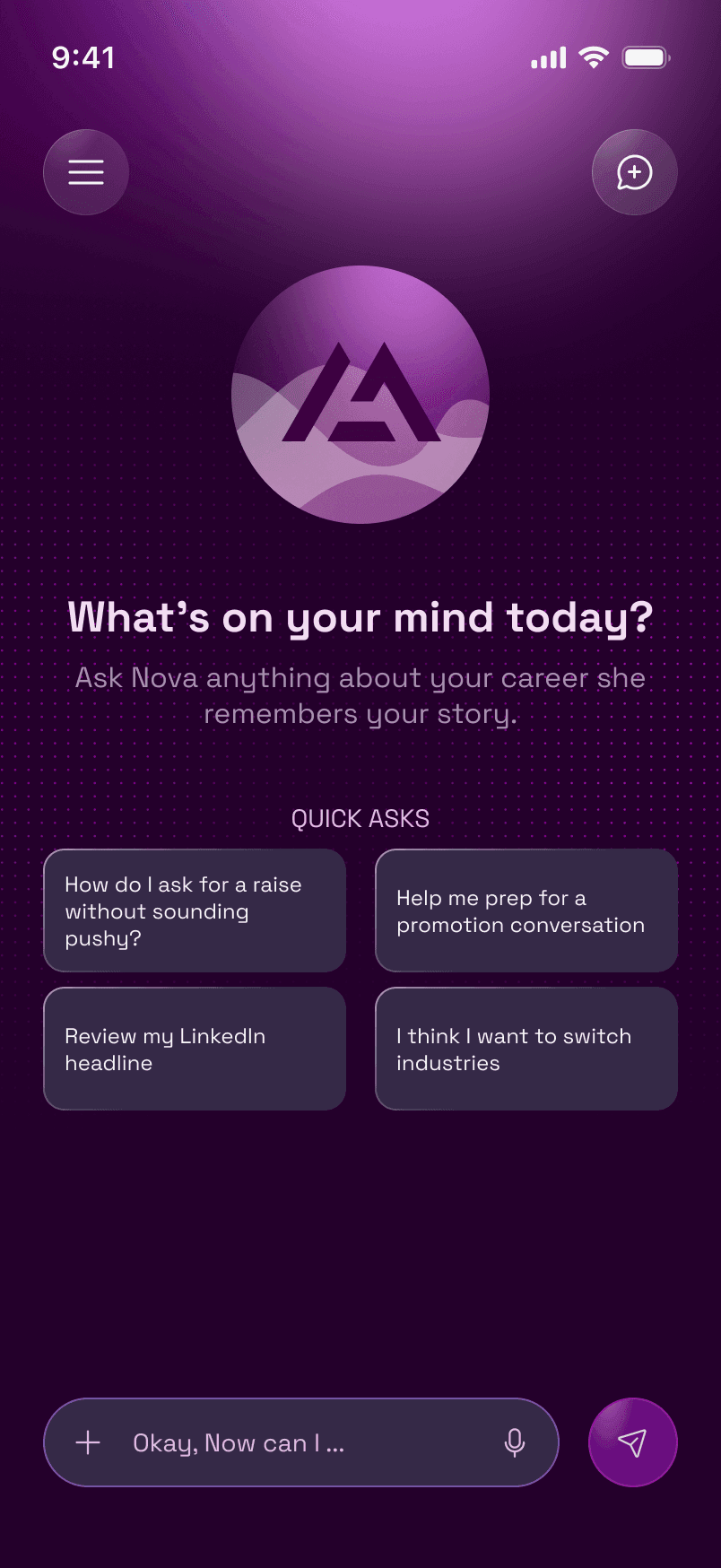
Your onboarding answer becomes Nova's first message.
- Three short questions instead of a long form: career stage, then "What's on your mind right now?"
- Why it matters: the first chat starts personal, so the user sees value in the first minute, not after setup.
- The home screen says it plainly: Nova remembers your story.
02 · Talk
The coaching chat
A focused chat that handles real work files.
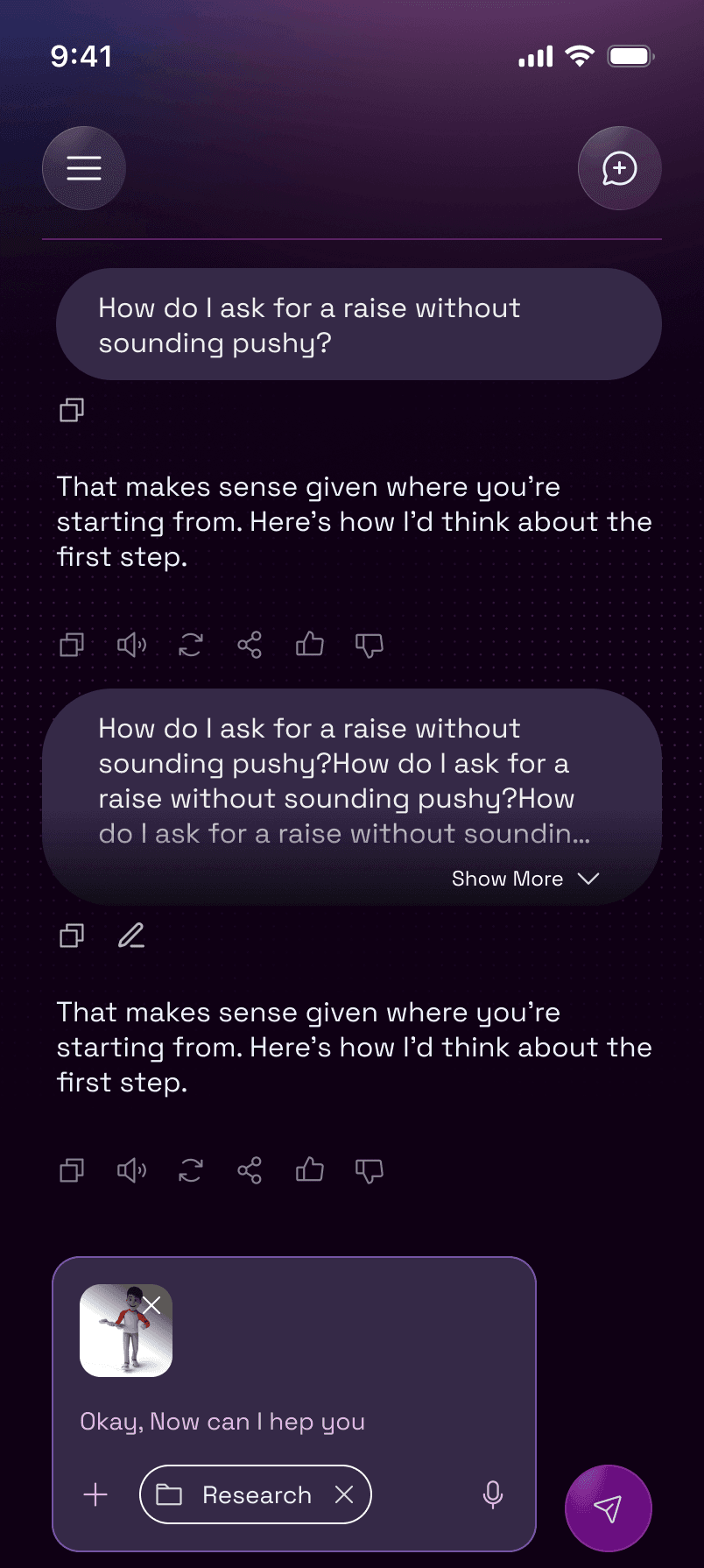
- Attach CVs, sheets and docs, including Arabic file names.
- Failure states are explicit: a file that couldn't be read says so, instead of the AI pretending it read it.
- Every answer has quick actions underneath, so users can reuse it, rate it, or dig deeper.
03 · Focus
One service, one job
Each service is one conversation for one goal: CV, interviews, salary, colleagues.
- The scope guard: go off-topic and Nova suggests a new chat instead of drifting.
- Why it matters: focused sessions give better answers and make each service worth paying for on its own.
- The CV service turns your CV into ready PDF templates inside the chat (ATS-friendly classic or modern).
04 · Escalate
From AI to a human, on your terms
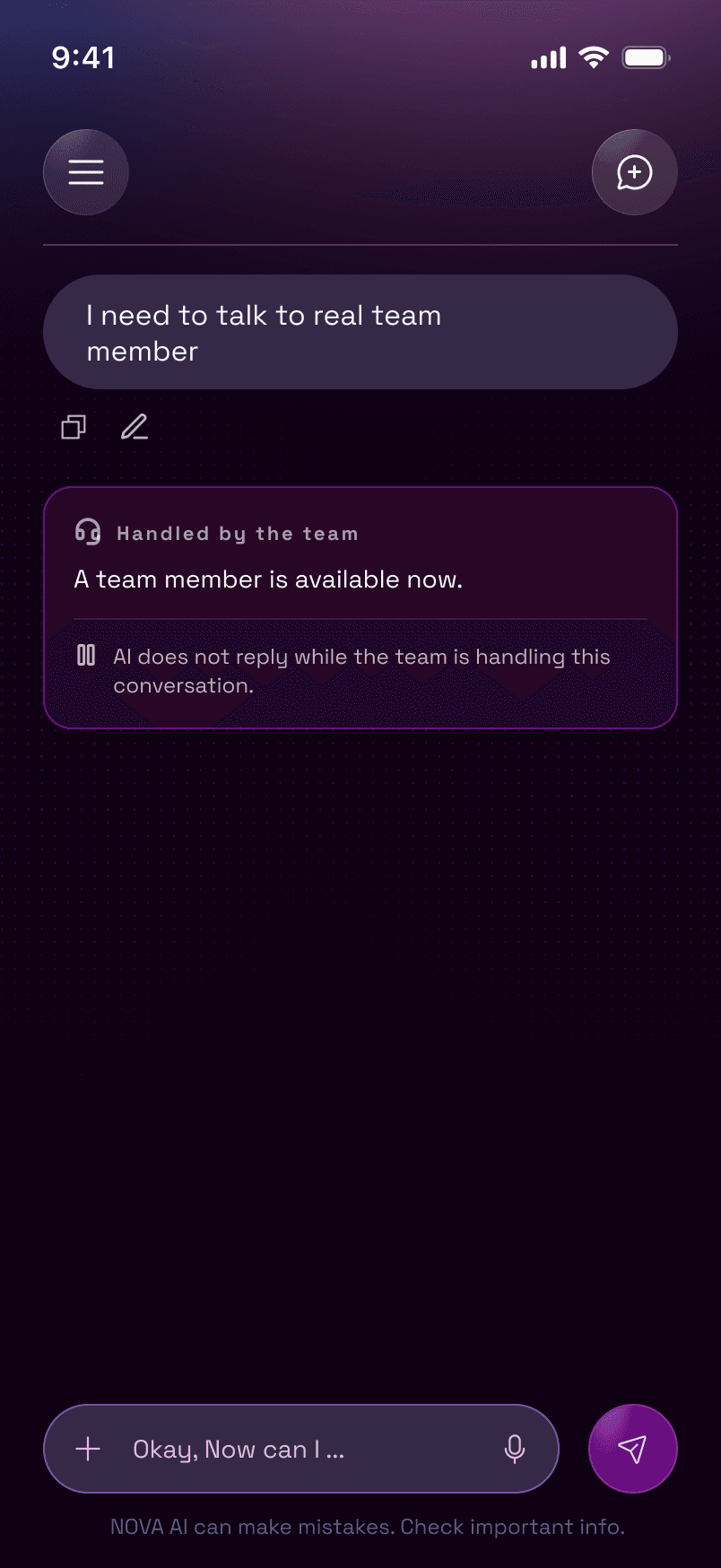
When the AI isn't enough, a human steps in, and the AI steps back.
- AI stops replying while the team handles the conversation. No two voices at once.
- Consent by design: taking over doesn't give the team your history. They ask, with a reason. You decide.
- The team can offer a paid 1:1 session: pick a time first, pay after. The refund rule (48 hours) shows before payment, and you can reschedule twice.
05 · Subscribe
Limits that lead somewhere
Hitting the limit is an upgrade moment, not an error.
- Usage is always visible: messages left, reset date.
- When the free limit hits, the upgrade card appears inside the chat, with plans or top-ups.
- Plans in EGP: 100 messages for 399, 300 for 599.
- Receipts show every payment attempt, even failed ones. Transparency builds trust with paying users.
06 · Anywhere
An app without an app store
Installed in three taps, usable offline.
- Install bar, plus a step-by-step iPhone guide (Safari hides this option).
- Offline mode: cached history stays readable and new messages wait to retry. No silent failure.
04 · Hand off & ship
- PRD broken into ClickUp epics and tasks, so engineering built from scoped, ordered work.
- Architecture I designed for: the coach's method in the system prompt, her content as a knowledge base, per-user memory, on the Claude API.
05 · Validate
- Reviewed in close sessions with the founder, who knows her users deeply.
- NovaMind is now live with its first subscribers.
Results
- Live with its first subscribers.
- Under 3 months from brief to launch.
- 70+ screens and states designed, from onboarding to receipts.
- 3 levels of help in one product: AI, human team, paid 1:1 sessions.
Related work for the same client: NovaMind website, the marketing site I designed for NovaMind, live at novamind.org.
What I learned & what's next
- Write down what the product is not. That list made more decisions than any feature list.
- Good AI products know their limits. The handoff and the scope guard build more trust than a smarter model would.
- Next: usability tests with real subscribers, and month-to-month retention to prove the memory bet.
Stack & tools
Design & product
- Figma
- PRD in Markdown
- OOUX object mapping
- Edge-case matrix
- ClickUp (epics & tasks)
- Magic Patterns (AI screen generation)
AI
- Claude API
- System prompt encoding the coach's method
- Knowledge base from the coach's content (RAG)
- Per-user memory
Product
- Installable web app (PWA)
- Offline mode with cached history
- Google Meet for 1:1 sessions
- RTL-ready layout